Find expertise
Discover relevant knowledge and competencies across teams and disciplines.
Foldercase connects organizations, people, projects, expertise, infrastructure, and partnerships into one navigable structural picture.
Most tools manage work. Foldercase maps how the work, people, knowledge, and relationships are structured around it.
Designed for structural collaboration — not for storing or exchanging sensitive data.
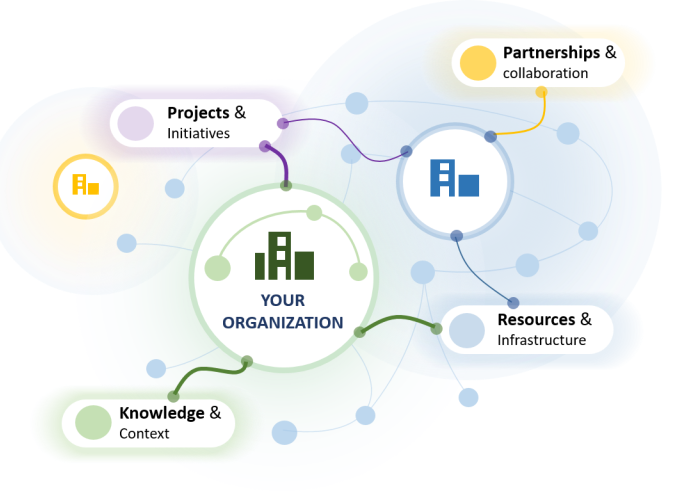
Modern organizations, research networks, and innovation ecosystems generate vast amounts of expertise, projects, infrastructure, partnerships, and knowledge. As they grow, visibility often decreases.
Instead of guessing how teams, projects, and responsibilities connect, make the structure visible and usable.
Discover relevant knowledge and competencies across teams and disciplines.
See how projects, resources, and responsibilities connect.
Make relationships between departments, partners, and institutions visible.
Maintain institutional context beyond documents and personnel changes.
Identify gaps, overlaps, and coordination risks in complex systems.
Select an element to see what becomes visible when it is connected to the rest of the ecosystem.
Connect people, teams, competencies, and areas of specialization so that expertise can be discovered beyond personal networks.
Represent ongoing and completed initiatives together with the people, expertise, resources, and organizations around them.
Connect infrastructure and resources to the people, projects, organizations, and capabilities that depend on or use them.
Map collaborations between departments, institutions, partners, and programs to reveal the structure behind cooperation.
Maintain a living representation of institutional knowledge so that relationships, context, and expertise remain understandable as organizations change.
The goal is not to replace every system. It is to make the structure between systems, people, projects, and organizations understandable.
Foldercase is especially relevant where knowledge, infrastructure, projects, and responsibilities cross organizational or disciplinary boundaries.
Make expertise, projects, infrastructure, and collaborations easier to discover across departments and institutions.
Connect people, capabilities, initiatives, and resources into a navigable institutional picture.
Make responsibilities, dependencies, stakeholders, and multi-organization relationships easier to understand.
Create a structural view across organizations, capabilities, infrastructure, and collaboration pathways.
Understand partners, capabilities, initiatives, and opportunities across a broader innovation ecosystem.
Expertise, decisions, relationships, and organizational context often remain valuable long after individual initiatives have concluded.
Foldercase helps preserve this structural context through a living representation of people, projects, expertise, infrastructure, partnerships, and their relationships over time.
The workflow is deliberately structural: identify the elements that matter, connect them, and use the resulting picture to understand the ecosystem.
Identify the organizations, people, projects, expertise, infrastructure, and relationships that matter.
Represent the relationships, responsibilities, dependencies, and collaboration pathways between them.
Navigate the ecosystem to find expertise, understand dependencies, and see how work connects.
Keep the structural picture useful as projects end, people change, and new relationships emerge.
Start with the people, projects, expertise, infrastructure, and relationships that matter most — then build from there.